In this edition of Leading the Way, Dalibor Petrović, Group Finance and Business Excellence Director, shares what shaped his view of business, Finance and leadership. From working across different markets to leading through complexity, he talks about the importance of understanding the business, making decisions without perfect conditions, testing assumptions and building teams that earn trust through results.
You have worked across Europe, the U.S. and India, in both large-scale and entrepreneurial environments. What has that taught you about business, people and decision-making?
The biggest lesson is that business today is very different from the business world I entered 15 years ago.
Back then, globalization, stable supply chains and predictable growth were often taken for granted. Recent global disruptions reminded us how quickly the environment can change. Suddenly, financing, energy, supply chains and wider market risks became part of everyday business discussions.
What has not changed is that every company faces challenges. It does not matter whether the company is large or small, local or multinational. The difference is usually not the challenge itself, but how organizations respond to it.
Working across different regions taught me that there is no single formula for success. In some environments, I saw a very pragmatic approach, with a strong focus on the few actions that create the biggest impact. In others, particularly in parts of continental Europe, there was a more structured approach, with thorough planning and clear roadmaps before major initiatives were launched. The UK experience showed me a strong combination of commercial discipline and adaptability, while India stood out for its entrepreneurial mindset, requiring strong governance and controls to support sustainable growth.
What I took away from all of them is that successful organizations are rarely the ones with the fewest challenges. They are the ones that adapt fastest, make decisions when information is incomplete and have people willing to take ownership rather than wait for perfect conditions.
Finance is often associated with numbers and control. In your view, what should Finance bring to the business beyond reporting?
Accurate reporting and strong controls will always be the foundation of Finance. Without them, it is difficult to make good decisions.
What is less discussed is that Finance also needs to be innovative.
Many finance professionals spend their careers identifying risks, ensuring compliance and explaining what can and cannot be done. Those responsibilities are important. But there is a danger in becoming too conservative and assuming that because something has been done a certain way for the last ten years, it is the only way it can be done.
In my experience, the real value of Finance comes from understanding the rules well enough to find solutions within them.
I remember a Supply Chain Director once jokingly telling me: “You people in Finance post one accounting entry and suddenly save a few hundred thousand euros, while we negotiate with suppliers for months to achieve those savings.”
From the outside, it can sometimes look that way. What people do not see is the analysis, interpretation of regulations, discussions with auditors and advisors, and the effort required to find a solution that works both commercially and from a compliance perspective.
For me, Finance is not just about reporting what happened. It is about helping the business move forward by combining discipline, creativity and problem-solving.
How do you balance financial discipline with the need for business speed?
I do not think the biggest challenge is balancing discipline and speed. More often, the challenge is balancing discipline and complexity.
Over time, organizations naturally accumulate controls, approvals and processes. Most of them are introduced for good reasons, but after ten years it is not unusual to find processes that nobody questions anymore simply because “that is how we have always done it.”
The problem is that complexity can become a risk in itself. It slows decisions, frustrates teams and sometimes prevents organizations from reacting when they need to.
At the same time, every change creates resistance. People are usually more comfortable with familiar processes than with uncertainty. The first reaction is often that something cannot be done when, in reality, it simply has not been done before.
My role is not to know everything. My role is to listen carefully, challenge assumptions and make the best decision possible with the information available.
For me, speed does not come from cutting corners, and discipline does not come from adding more controls. The goal is to make sound decisions at the right time and help the business move forward even when certainty is not available.
When you look at Frontier Zdravlje, where do you believe Finance can create the most value?
I believe Finance creates value only after it understands how the business itself creates value.
What creates value in a startup is different from what creates value in a mature company. What works in a multinational organization may not work in an investment-backed business. Before Finance can improve anything, it needs to understand the industry, the business model and the challenges the company is actually facing.
In my experience, most organizations already know where improvements are needed. The issue is rarely awareness. More often, it is about turning that awareness into execution.
In many organizations, constraints can sometimes become accepted too quickly. There is no budget. The project is too expensive. Resources are limited. The current process is not ideal, but it works. The challenge is to keep testing those assumptions instead of allowing them to stop progress.
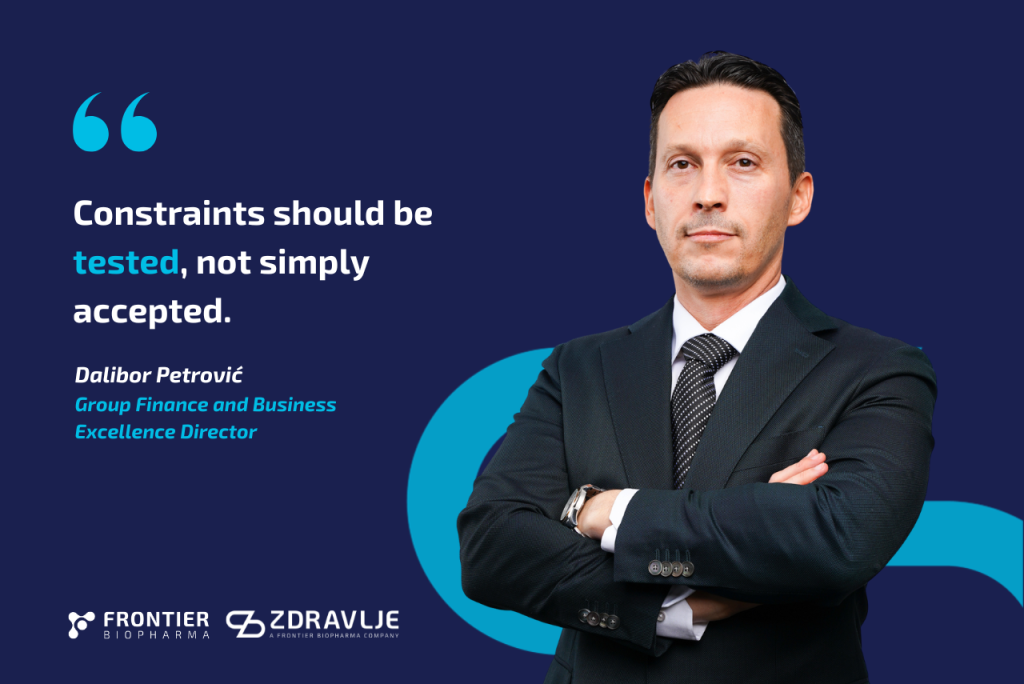
I have always believed that constraints deserve to be tested. If there is no budget, can we create one? If the cost is too high, can we redesign the approach or introduce competition? If a process creates inefficiencies, can we simplify it or organize it differently?
For me, Finance creates value by helping turn discussions into decisions and decisions into actions. Reporting, controls and compliance will always be important. But ultimately, value is created when problems are solved, processes improve and the organization becomes more efficient, scalable and competitive than it was before.
Where does real business improvement usually start: with processes, decisions, ownership or mindset?
If I had to choose one, I would start with understanding.
Before changing anything, you need to understand the problem, the process and what is actually preventing improvement. Most organizations already know where many of their challenges are. What they often lack is not awareness, but action.
In my experience, business improvement does not usually fail because there are no ideas. More often, progress is slowed because decisions are delayed, ownership is unclear or people are waiting for perfect conditions that never arrive.
This is where leadership becomes important. Someone has to make a decision, take responsibility and demonstrate that progress is possible.
What I have learned over the years is that mindset is usually not the starting point. People do not change their mindset because they attended a presentation or heard a new slogan. They change it when they see results. When a difficult problem gets solved, when a process improves, or when an initiative once considered impossible becomes reality, skepticism starts to disappear.
That is why I believe real business improvement starts with understanding and ownership. Decisions and execution create results. Results change mindsets.
In Finance, credibility matters a lot. How do you build a team that is not only technically strong, but also trusted, proactive and close to the business?
I believe credibility is built over time and earned through results. Titles can create authority, but credibility comes from consistently delivering, solving problems and being someone others can rely on when things become difficult.
That applies to leaders as much as it applies to teams.
Technical competence is essential, especially in Finance. At the same time, I do not believe every successful finance professional needs to look the same.
Strong teams are built around different strengths. Some people are exceptional technical experts. Some are naturally proactive and business-oriented. Some become outstanding accounting leaders because they genuinely enjoy structure, accuracy and technical excellence. Not everyone has the same career ambition, and that is perfectly fine.
My role is to understand those strengths, help people develop and create an environment where different capabilities complement each other.
I am not a fan of micromanagement. People become proactive when they are trusted, given responsibility and understand how their work contributes to the business.
Over time, people gain confidence through experience, credibility through results and a stronger connection to the business by seeing the impact of their work beyond the numbers.